Workflow Automation Consulting Services
When every software demo looks promising, it helps to step back. Workflow automation consulting services exist to slow down the tool selection and speed up the thinking. VKTIS starts with how your team actually works, maps where decisions go wrong, and turns the problem into a plan someone can actually execute. Before you buy another subscription or migrate to a new platform, it helps to know whether the process itself is ready to support it.

What Workflow Automation Consulting Covers
This engagement is not an audit alone, and it is not custom development. A workflow audit diagnoses a specific process. Custom development builds a defined solution. Consulting sits between those two: it takes findings from an audit or discovery session and works them into an implementable plan.
The proposed scope covers current-state process mapping, options analysis, technology evaluation, staffing decisions, and an ordered roadmap. Estimates within that roadmap are labeled as estimates. A roadmap is not a promise of financial return, and implementation, subscriptions, and ongoing support are separate unless the engagement agreement explicitly includes them.
For teams ready to build, workflow automation implementation services turn approved requirements into tested systems. Explore business process automation for that scope.
Three Layers of Responsibility
Understanding who does what prevents both over-automation and under-staffing.
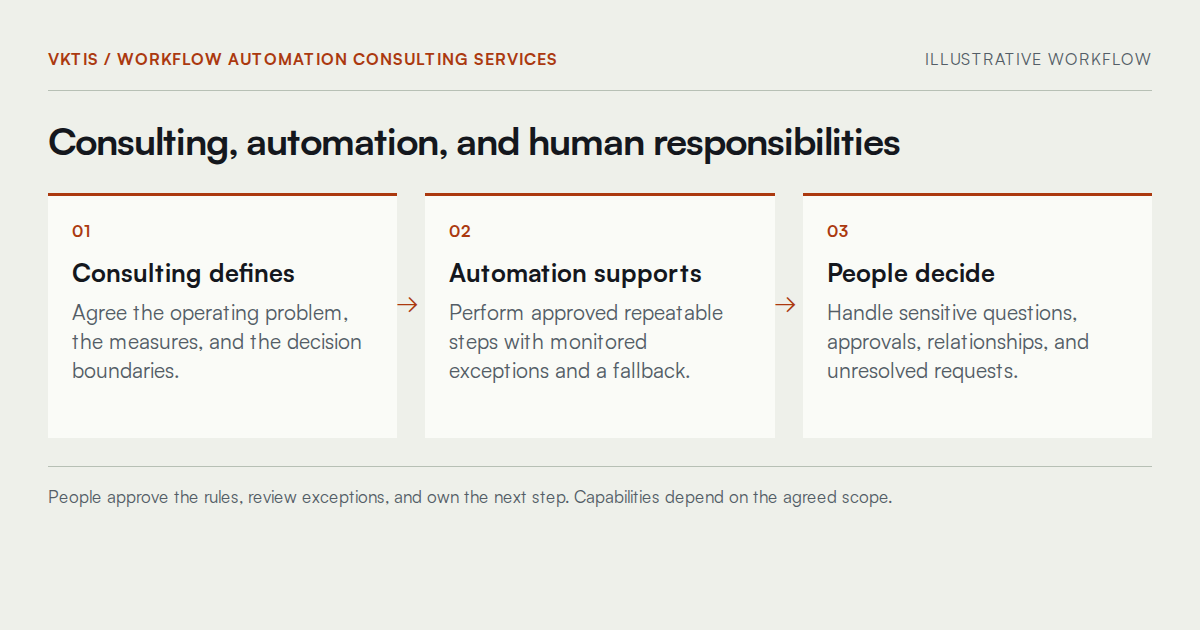
Consulting defines the operating design
Consulting identifies the problem worth solving, agrees on the measures that would indicate improvement, and sets the decision boundaries for any automated steps. This layer compares process changes, existing tool features, and new integrations before any selection is made.
Automation supports bounded repeatable work
Automated steps should use authorized data, operate within defined permissions, and record failed or uncertain actions so a person can review them. Automation supports approved routines; it does not replace judgment about sensitive or ambiguous situations.
People own decisions and relationships
Your team retains authority over customer commitments, approvals, and material decisions. A shared queue or inbox is useful only when a named person is responsible for it. Confirm staffing, coverage, and escalation in writing before any workflow goes live.
Workflow Automation for Home Services Businesses
Scheduling, dispatching, follow-up, and billing create a high volume of repeatable touchpoints in home services operations. The process gaps that cause friction, missed callbacks, unclaimed leads from the evening hours, or technician notes that never reach the billing team, are often ownership problems before they are technology problems.
Consulting for a home services business typically maps the inquiry-to-invoice path, identifies where handoffs break down, and recommends a combination of process changes and automation that accounts for after-hours coverage. For practices that want to explore dedicated phone support, the AI receptionist for plumbers page covers a more specific option. A workflow audit is also available if you want a diagnostic before committing to a full roadmap engagement.
Workflow Automation for Medical and Dental Practices
Medical and dental practices carry particular obligations around data handling, access permissions, and patient communication. VKTIS does not make clinical recommendations or compliance determinations. What consulting can do is map the administrative workflow: new patient intake, appointment reminders, follow-up tasks, referral tracking, and internal handoffs between front desk and clinical staff.
The consulting process identifies which administrative steps are candidates for automation, which require a trained staff member, and where documentation gaps could create downstream problems. Staffing decisions and exception handling for sensitive communications stay with your team. For practices exploring dedicated front-desk support, the AI receptionist for dentists page describes a more specific service offering.
Workflow Automation for HVAC Companies
HVAC companies deal with seasonal demand surges that expose process weaknesses that are tolerable in slower periods. Missed dispatch confirmations, unsent maintenance reminders, and service agreements that expire without renewal follow-up are common examples. These are coordination problems, and they become more costly when call volume is high.
A workflow automation consulting firm working with an HVAC company would typically start by mapping the service request lifecycle, from first contact through technician dispatch, completion, and invoice. The review identifies where delays accumulate and whether technology, staffing, or a process change is the appropriate response. For teams considering call coverage support, the HVAC answering service page outlines a complementary option.
Adoption, Governance, and Ongoing Maintenance
A workflow change that staff do not understand or trust will be worked around. Adoption is not a training event; it is a design consideration that begins during the scoping phase. When staff members are interviewed during mapping, their workarounds reveal what the formal process does not account for. Incorporating those findings into the design reduces resistance later.
Governance means naming who can modify a workflow, under what conditions, and how those changes get documented. For automated steps, it also means defining how staff return to a manual process if a connection or automated action fails. Maintenance responsibilities, including who monitors exceptions and who updates logic when business rules change, should be confirmed in writing as part of any handover.
Evaluation Without Assumed Outcomes
Measuring improvement requires agreeing in advance on what you are measuring. Useful metrics for most workflow changes include rework volume, unresolved task counts, cycle time per completed task, and cost per completed task. These are trackable without assuming a specific savings percentage or return.
A workflow automation consulting company should not promise financial outcomes it cannot control. Staff adoption, system reliability, data quality, and process adherence affect results. Ask for a plan grounded in current conditions, with acceptance criteria defined before implementation. Those criteria give your team a basis for reviewing the work and identifying what still needs adjustment.
For teams that want to understand readiness before committing to a full consulting engagement, the automation readiness assessment is a reasonable starting point.
What the Scoping Deliverable Actually Contains
Many buyers enter a consulting engagement unsure what they will receive at the end. For workflow automation consulting services, the primary deliverable at the conclusion of the scoping phase is a structured roadmap document that your team can act on, hand to an internal developer, or use to evaluate competing vendors.
Current-state summary and gap inventory
This section of the deliverable documents how the process actually works today, including the informal steps, workarounds, and exception-handling patterns your staff described during interviews. Each gap is categorized by type: ownership gaps, data-quality gaps, handoff breakdowns, or tooling limitations. That categorization matters because different gap types call for different remedies. An ownership gap rarely resolves with a software purchase.
Options analysis and sequencing logic
For each prioritized gap, the deliverable presents at least two response options, compares their estimated effort and dependencies, and recommends an order of implementation. The sequencing follows a principle of reducing rework first, so that later automation steps operate on cleaner inputs. Estimates within the options analysis are explicitly labeled and reflect available information at the time of scoping, not guaranteed timelines or outcomes.
Choosing Between Consulting, an Audit, and Custom Development
Buyers comparing service types often conflate these three, which leads to mismatched expectations before a project begins. A workflow audit produces a diagnostic: it tells you what is broken and roughly why. Custom development takes a fully defined specification and builds the solution. Workflow automation consulting services fill the gap between those two, converting a diagnosis into a tested, sequenced, and staffed plan.
When an audit is sufficient
If your team has a clear hypothesis about a single process and needs external confirmation, a scoped audit may resolve the question without a full consulting engagement. Audits work well when the problem is localized, the ownership structure is already sound, and the main question is whether a specific automation is justified. They are less useful when the process spans multiple roles or systems and the failure points are still unclear.
When custom development is the right next step
Custom development makes sense after consulting when the requirements are fully specified, the decision boundaries for automated steps are documented, and a named owner is in place for exceptions and maintenance. Engaging a developer before those conditions are met tends to produce software that works as built but does not match how the team actually operates. Consulting reduces the revision cycles that follow a misaligned build.
When consulting is the appropriate fit
If you have findings from a previous audit, persistent process failures despite earlier software purchases, or a planned platform migration with no agreed workflow design, consulting is likely the appropriate entry point. The business consulting and operations support page describes the broader operational context in which workflow consulting often sits.
Practical Failure Scenarios Worth Planning For
Understanding where workflow automation projects commonly stall helps your team design around those risks before implementation begins. These are patterns that surface during consulting work, not guarantees about what you will encounter.
The handoff that no one owns
A common failure pattern involves an automated notification that delivers correctly but lands in a shared inbox with no assigned owner. The automation runs as designed. The task still falls through. This is an adoption and governance failure, not a technology failure, and it is preventable when the scoping phase explicitly assigns coverage and documents what happens when that person is unavailable.
The exception that became the default
Automated workflows are designed around the expected case. When the unexpected case is frequent enough to become the default, staff begin manually overriding the workflow and the automation loses value. During scoping, the volume and pattern of current exceptions should inform whether a step belongs in an automated path at all, or whether it needs a human decision point built into the design.
Cost components that appear after launch
The initial subscription or build cost is rarely the total cost of a workflow change. Related costs that appear during or after implementation include data migration and cleanup, staff time during parallel-run testing, revision cycles when business rules change, and ongoing monitoring if no one is formally assigned to exception review. Confirming these components in writing before implementation begins is part of responsible scoping.
Keep the roadmap editable. Revisit priorities when operating conditions change.
What to Bring to the First Conversation
The most useful starting point is a walkthrough of the process as it actually runs, not as it appears in a procedures document. Bring a description of where work waits, who currently owns the next action, and what solutions have already been tried. Note the tools involved, the recurring exceptions your team handles, and whatever operational data you already trust.
Do not send sensitive customer records before a data-handling scope has been agreed. A description of the problem is enough to determine whether consulting, a more targeted workflow audit, or another service path is the right fit.
To discuss your setup, contact VKTIS or book a 15-minute intro call to describe where the process is breaking down and what you have already tried to fix it.