HVAC Answering Service for Residential and Commercial Businesses
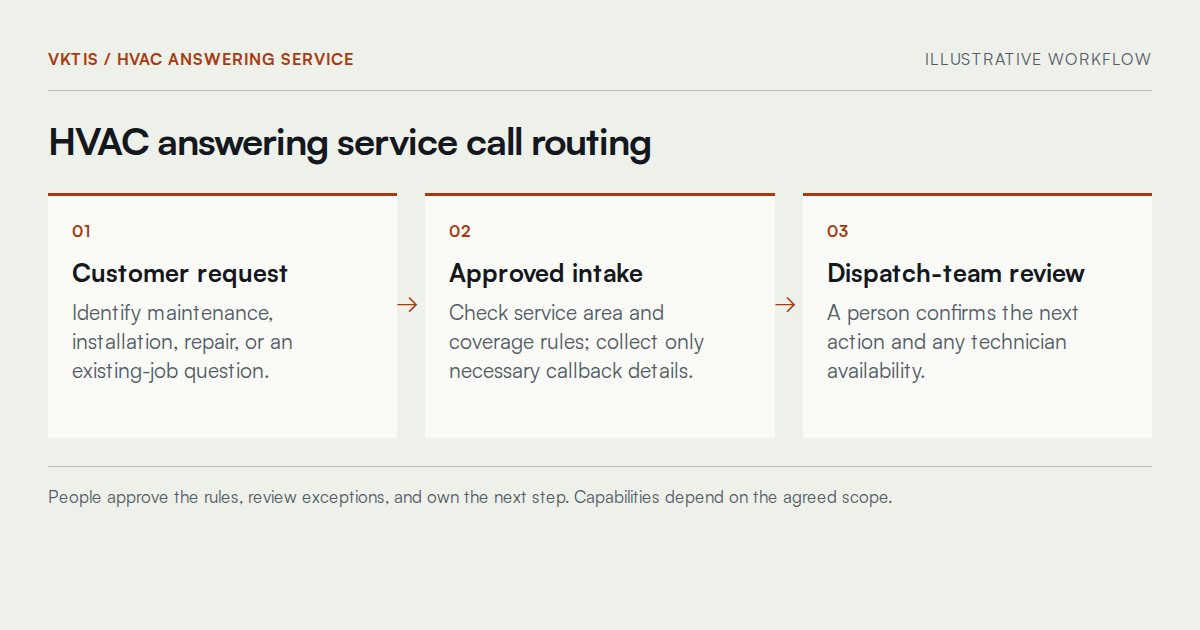
Managing inbound calls during a busy season is one of the most practical operational problems an HVAC business can solve before the phones get loud. A well-scoped HVAC answering service separates routine maintenance inquiries, new installation questions, existing-job updates, and after-hours requests into clear, owned queues instead of a single pile. VKTIS works with residential HVAC, commercial HVAC, and heating and cooling repair businesses to scope and implement structured call intake workflows that route each request to the right person, with the right context, at the right time.
What a Scoped HVAC Answering Service Can Cover
A scoped implementation starts with defining the categories of work your office actually coordinates: preventive maintenance scheduling, new system installation inquiries, repair and diagnostic requests, and existing-customer job updates. Each category has a different urgency, a different owner, and a different next action.
An AI-assisted intake layer can collect the caller's name, callback number, service address, and the general nature of the request. It does not confirm technician availability, estimate repair costs, or make dispatch decisions. Those responsibilities stay with the office team under a human review step that is defined before any workflow goes live.
Illustrative Workflow: How Intake Categories Route Differently
The following is an example scenario, not a client result or a guaranteed outcome.
Maintenance Request
A caller asks about an annual tune-up. The intake workflow captures the service address, preferred callback time, and equipment type. A scheduling action is only used after the calendar integration and appointment rules have been tested and approved by the office team.
Installation Inquiry
A caller wants a quote for a new system. The workflow creates a follow-up task and assigns it to an owner. An inquiry is not a confirmed installation, a binding price, or a reserved technician. The task sits in a visible queue until a person acts on it.
After-Hours or Uncertain Request
The workflow uses the approved callback language or on-call handoff. It does not imply immediate attendance, diagnose equipment, or perform autonomous emergency triage. The business defines acceptable response language before the system goes live.
Residential HVAC: Managing Homeowner Calls at Volume
Residential HVAC demand can change sharply with weather. Plan intake capacity around your own call logs rather than an assumed peak. The practical challenge is to give callers accurate expectations about the next step while making overflow and failed transfers visible to your office.
A residential intake workflow should collect the homeowner's details, the nature of the problem, and the service address without implying a same-day repair slot that the dispatcher has not confirmed. When the team is available, the handoff is smooth. When the team is in the field, the caller has a clear callback expectation rather than silence. For related intake design thinking, see our notes on AI receptionist workflows for service businesses.
Commercial HVAC: Building Contacts, Tenants, and Dispatcher Handoff
Commercial calls introduce a different coordination layer. A facilities manager calling about a multi-unit building may represent several units, multiple contact types, and a service agreement that has its own priority rules. The intake workflow must capture the building contact, not just a caller name, and route the request to whoever owns the commercial account relationship.
Dispatch handoff in a commercial context also involves confirming whether the site is under an active service agreement, what the approved access procedure is, and who at the building receives status updates. These details belong in the intake form, not in a technician's voicemail. Documenting them at the point of first contact reduces the time spent reconstructing call context later.
Evaluating the Best HVAC Answering Service Provider for Your Business
Buyers asking how to find the best HVAC answering service provider for their specific situation should compare providers on practical operational criteria rather than rankings or labels. Relevant factors include concurrent-call limits during a surge, transfer behavior when the first destination does not answer, compatibility with the dispatch tool already in use, and total cost relative to the volume of calls handled.
Testing matters more than stated features. A realistic evaluation runs a routine inquiry through the system and then tests a failed handoff to see what the caller experiences. Providers that cannot demonstrate how they handle overflow or transfer failure introduce more risk during a seasonal peak than they resolve. VKTIS can help structure that evaluation as part of a workflow audit before any implementation decision is made.
24/7 HVAC Answering Service: Scope and Honest Expectations
A 24/7 HVAC answering service is an option that depends on the phone platform, the intake rules, and the human coverage plan behind it. Around-the-clock intake is not the same as 24/7 human staffing or emergency technician availability, and those three things must be confirmed separately before a business represents its coverage to callers.
What a configured system can potentially do outside business hours is capture a service request, set an accurate callback expectation, and route the information to whoever reviews the queue in the morning or on-call. What it should not do is imply that a technician is available or make a safety assessment on the team's behalf. Both the intake language and the escalation path must be reviewed and approved before the after-hours workflow handles a real call.
Scoping, Testing, and Maintenance Before and After Launch
A responsible implementation defines intake categories and ownership before configuration. Test representative calls, failures, and ambiguous requests, then launch under an agreed review period. Include busy lines, unavailable staff, and callers who request a person so that the fallback is as clear as the normal path.
After launch, maintenance means reviewing unresolved requests, tracking successful callback completions, catching booking errors, and updating the workflow when service area rules or office hours change. A workflow that was accurate in April may need review in July. VKTIS supports both the initial scoping and ongoing operational review as part of business consulting and operations support.
What the Scoping Process Actually Produces
When VKTIS scopes an HVAC answering service engagement, the output is a written intake specification, not a vague plan to configure something later. That document defines each call category, the data fields collected per category, the routing destination, the fallback behavior when the primary destination does not answer, and the human review step that sits between intake and action.
Deliverables in a Scoping Engagement
The intake specification becomes the reference document the implementation is built against and the benchmark the testing phase is measured against. It captures the service area rules, the approved callback language for after-hours callers, and the escalation path for requests that do not fit a standard category. Having that document means the office team can evaluate whether the configured workflow matches what was agreed before a single real call reaches it.
When Scope Reveals a Process Gap First
Scoping sometimes surfaces decisions that the business has not formally made. Common examples include whether a commercial tenant call and a facilities manager call route to the same owner, or whether a callback promise during a surge is two hours or next business day. Those decisions belong to the office team, and scoping is the structured moment to make them explicit rather than leaving them to be improvised during a peak afternoon.
A Worked Example: Heating and Cooling Repair Business in a Summer Surge
The following is an illustrative scenario constructed to show how intake categories behave differently under load. It does not represent a specific client, a real deployment, or a guaranteed outcome.
The Setup
A heating and cooling repair business with two technicians and a part-time office coordinator handles roughly 15 to 20 inbound calls on a normal day. On the first week of a heat advisory, that volume roughly doubles and the coordinator cannot answer every call before the next one arrives.
How a Scoped Intake Layer Might Respond
Under a configured intake workflow, calls that arrive while the coordinator is on another line are routed to an intake step that collects the caller's name, callback number, service address, and whether the issue involves an existing repair visit or a new request. Routine maintenance inquiries are separated from urgent cooling-failure reports at the point of first contact. The coordinator opens one queue in the morning with each item already categorized, rather than a single list of voicemails requiring individual reconstruction. The system does not assign technicians, confirm slots, or quote repair costs. Those actions remain with the coordinator and are taken only after the queue has been reviewed by a person.
Understanding Cost Components Before Committing to a Platform
Buyers evaluating an HVAC answering service often receive a per-minute or per-call figure without a clear view of what that number excludes. Understanding the full cost picture before committing to a platform prevents budget surprises after the workflow is already live.
Platform and Configuration Costs
Most phone intake platforms carry a base subscription cost that is separate from usage fees. Configuration work, including building the call tree, writing the intake prompts, and connecting the platform to a receiving inbox or CRM, is typically billed as a one-time or project-based cost rather than included in the subscription. VKTIS scopes configuration as a defined deliverable so the business knows what is covered before work begins. For an overview of how implementation is priced, the pricing page outlines the engagement structure.
Ongoing Maintenance and Review Costs
A workflow that is accurate when launched will require updates as service area rules change, office hours shift, or new call categories emerge. Treating ongoing maintenance as a zero-cost assumption leads to outdated intake language and routing rules that no longer match how the business actually operates. Building a review cadence into the initial engagement, rather than addressing it only when something breaks, keeps the workflow aligned with the real state of the business. VKTIS offers ongoing operational review as part of business consulting and operations support for businesses that want a structured maintenance arrangement rather than ad hoc fixes.
Review greetings after seasonal changes. Remove expired offers and outdated office coverage statements.
A Useful First Step Before Committing to an Implementation
The most practical first step for most HVAC businesses is a focused conversation about the categories of calls you receive, who currently owns each category, and where the visible gaps are during a peak period. That conversation informs the scope of any implementation and often surfaces process decisions that need to be resolved before any technology is useful.
You can reach the VKTIS team through the contact page or book a 15-minute intro call to discuss seasonal demand, service categories, and how human review would work in your specific setup. The call is a planning conversation, not a commitment to any particular solution. Your team retains control of availability decisions, dispatch, and customer follow-up from the first day forward.