
Business Process Automation Services
Business process automation services connect the steps between teams rather than just speeding up a single task. Handoffs can introduce missing information, unclear ownership, skipped approvals, or gaps in the activity record. VKTIS helps scope, design, and implement automation from trigger to recorded outcome, including defined exception routes. The goal is a visible, measurable process where a responsible person owns each stage and automation supports rather than replaces human judgment.
Process Management Comes Before Software
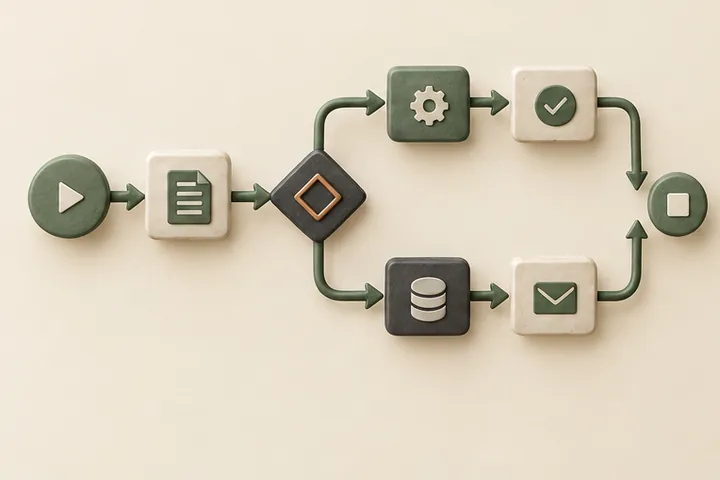
Business process management services and software automation are not the same thing. Process management defines the start event, the end condition, every actor involved, the information required at each stage, and what happens when something goes wrong. Only once those decisions exist does it make sense to automate anything.
Skipping the design stage typically produces faster confusion rather than faster work. Automation applied to an unclear process moves tasks more quickly to the next point of ambiguity. A scoped engagement with VKTIS starts by documenting the process on paper before selecting any tool.
Rules Before AI
Many repeatable processes do not require AI at all. Deterministic rules, conditional logic, and existing software features can route work, trigger reminders, and enforce approval gates without machine learning. VKTIS considers AI business process automation services only where interpreting variable or unstructured input is genuinely useful and where the output can be reviewed by an appropriate person before consequential action is taken.
Scoping a Process: What the Work Requires
A scoping conversation covers the trigger that starts the process, the information required to proceed, the people and roles involved, the decision points, and the conditions that would send the process down an exception path. That scope document becomes the basis for any build.
Proposed scope typically includes the defined start and end, a list of required inputs, ownership at each stage, approval conditions, exception routes, and a measurement plan. The measurement plan focuses on process outcomes such as completion rate and overdue items rather than message volume or notification counts.
What Happens After the Easy Step
A form-to-email connection is a common first automation, and it is useful. But the work rarely ends there. The approval still needs to happen, missing information still needs to be requested, the follow-up still needs a deadline, and the final record still needs to be written. Custom business automation solutions built with VKTIS are designed to cover the full path, not only the first trigger.
Exception Paths and Human Boundaries
Exception handling deserves its own design review. The happy path describes complete information and normal approvals. Exception paths explain what happens when a field is missing, a reviewer is unavailable, an internal target passes, or an input falls outside expected parameters. Test both paths before staff depend on the workflow.
VKTIS treats exception design as a required deliverable, not an optional add-on. Each exception route should lead to a specific owner, a documented manual fallback, and a record that the exception occurred. Staff should always have a way to intervene, override, or escalate.
Notification Design
Notification overload undermines adoption. A useful rule is to send event-specific alerts to the role that owns the next action, and to limit exception alerts to a small number of meaningful signals. Sending the same update to every person by default produces noise and reduces the value of the alerts that actually matter.
Home Services: Onboarding, Scheduling, and Follow-Up
Home services businesses often run repeatable processes across customer intake, scheduling confirmation, technician dispatch, and post-job documentation. Each of those steps involves a handoff between the customer, the office team, and the field team, and each handoff is a potential failure point.
A scoped automation build for a home services company might address customer intake validation, job record creation, internal task assignment, and completion confirmation. AI receptionist capabilities for plumbers may be a relevant adjacent service depending on how the intake process is structured. Scope, ownership, and manual fallback rules would be agreed before any build begins.
*Illustrative example, not a client result:* A new customer request arrives. The workflow validates required fields, creates a job record, assigns the appropriate team member, and holds scheduling confirmation until a required internal check is complete.
Medical and Dental Practices: Intake, Records, and Internal Routing
Medical and dental practices handle patient intake, document collection, internal review steps, and follow-up scheduling as repeatable processes. Each has information requirements, compliance-adjacent considerations, and staff ownership rules that need to be mapped before automation is introduced.
VKTIS does not make clinical recommendations and does not provide compliance determinations. What scoped business process automation services can address is the routing logic: who receives a form, what information is required to proceed, which step requires a staff review, and how incomplete submissions are flagged. An AI receptionist for dental practices may be a related consideration for the intake portion of that workflow.
Any step involving clinical judgment, sensitive patient communication, or regulated documentation should remain with the appropriate authorized staff member. Automation supports the routing and record steps, not the decisions within them.
HVAC Companies: Dispatch, Approvals, and Seasonal Volume
HVAC companies face process challenges that intensify with seasonal demand: incoming service requests, technician dispatch, parts ordering approval, and invoice follow-up all need to move quickly and with clear ownership. When those steps are manual or fragmented, bottlenecks appear at the same points every season.
A scoped process build might cover how a service request is validated, how it is assigned and confirmed, and how the completion record triggers the billing step. The HVAC answering service and related workflow tools can connect to that broader process where scope allows. Approval rules for parts spend or subcontractor authorization should be defined by the business and enforced by the process, not determined by the automation itself.
Implementation, Testing, and the Build Process
A VKTIS implementation follows documented scope. The proposed workflow covers capturing the request, validating the required information, routing the work to the correct owner, and closing and recording the outcome. Each stage is tested against the defined conditions before the process is marked ready.
Testing covers the happy path and the exception routes. If an exception path leads to an unclear outcome during testing, the scope is revised before launch. Workflow automation consulting services and a workflow audit are available as earlier-stage engagements for organizations that are not yet ready to build.
Measurement After Launch
A process without measurement is difficult to improve. The measurement plan agreed during scoping defines which signals matter: task completion rate, overdue exceptions, escalation frequency, and cycle time from trigger to recorded outcome. That plan is built around the process rather than around the volume of messages a tool sends.
What a Scoping Deliverable Actually Contains
Before any tool is selected or workflow built, VKTIS produces a written scope document that the client reviews and approves. That document is not a project proposal in the generic sense. It is a structured record of every decision that the build will depend on.
The Contents of a Scope Document
A completed scope document for a business process automation engagement typically includes the named trigger event, the explicit end condition, a role-by-role ownership map, all required inputs at each stage, defined approval conditions, exception routes with named fallback owners, and the agreed measurement signals. Each section reflects decisions made with the client, not assumed by the consultant.
The document also notes which steps will remain manual and why. If a step involves a financial threshold, an employment decision, or a compliance-adjacent review, the scope document identifies that step as requiring an authorized human action rather than automated routing. That boundary is agreed in writing before build work starts.
Choosing Between a Platform Build and a Custom Workflow
Buyers often face a choice between configuring an existing platform feature and building a more tailored workflow. Both approaches are legitimate, and the right answer depends on how closely the available platform logic matches the actual business rules.
When Platform Configuration Is Enough
Platforms such as practice management systems, field service tools, and CRM products often include built-in approval workflows, task assignment rules, and notification triggers. If those features match the agreed scope, configuring them is faster, carries lower ongoing maintenance, and keeps staff working inside a familiar interface. VKTIS scoping work identifies whether the existing platform can carry the required logic before proposing a separate automation layer.
When a Separate Workflow Layer Makes Sense
A separate workflow layer becomes worth considering when the process crosses multiple platforms, when the approval logic is more conditional than the built-in feature supports, or when exception routes need to trigger actions in a system the platform does not connect to natively. The trade-off is additional configuration complexity and a second system to maintain. That trade-off should be made deliberately and documented in scope, not defaulted into because a particular tool is already in use.
A Common Failure Pattern: The Orphaned Approval Step
One of the more predictable failure scenarios in process automation is the approval step that was added to the design but never connected to an owner with a deadline. The system sends a notification, the approver receives it, and then nothing enforces what happens next.
Why It Happens and How to Prevent It
Orphaned approvals usually appear when scope work focuses on the trigger and the output but skips the middle. The approval gate exists in the diagram, but no one has decided what happens if the approver does not act within a defined window. Does the task escalate? Does it pause? Does a second person receive an alert?
Preventing this requires that every approval step in the scope document names a role, a condition, a deadline, and an escalation route. If any of those four elements cannot be agreed during scoping, the step is not ready to build. VKTIS treats an unresolved approval step as an open scope question, not a minor detail to handle after launch. Businesses evaluating whether their current processes have this gap may find the workflow audit a useful starting point before committing to a full build.
Include a manual rehearsal before configuration. Walking through an exception together can reveal missing approvals before they become software requirements.
Your Next Step
The most useful thing you can bring to a first conversation is a description of a repeatable process and what currently happens when something goes wrong. That reveals the ownership decisions, exception routes, and fallback rules a build will require, and it allows VKTIS to propose a scope that covers the full path rather than only the first trigger.
You can contact VKTIS here or book a 15-minute intro call to describe the process you have in mind. If you are not yet sure whether a build is the right step, the automation readiness assessment is a useful place to start.