
AI Chatbot Development Services for Home Services, Medical, and HVAC Businesses
AI chatbot development services are about more than placing a chat window on a website. The real work begins when you decide which questions the chatbot can answer, where those answers come from, how the bot behaves when it is uncertain, and how a visitor reaches a person when the conversation exceeds the bot's approved scope. VKTIS approaches this as a scoping and implementation challenge, not a software installation. Before any interface is built, the knowledge behind it needs to be prepared, owned, and limited to what the business can actually support.
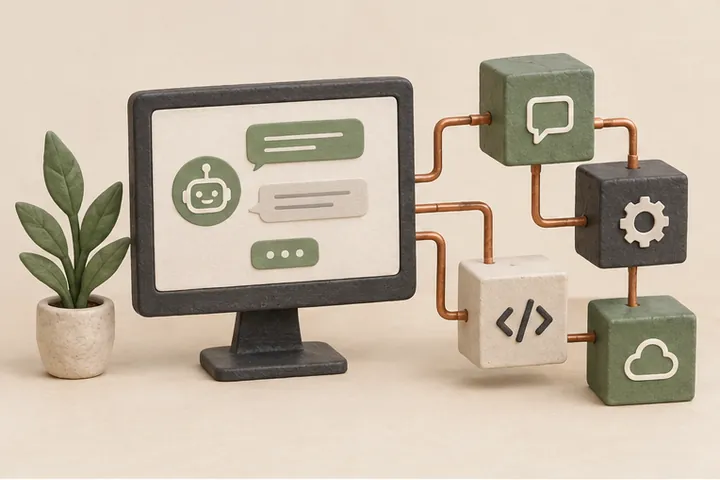
Scoping an AI Chatbot: Where the Work Actually Starts
Before writing a single conversation flow, VKTIS works with you to define what the chatbot is permitted to do. A customer-support chatbot, a lead-intake assistant, and an internal knowledge tool each require different permissions, data handling rules, and escalation paths.
Scoping covers allowed topics, fallback behavior when a question falls outside approved content, what information must not be collected through the chat interface, and which scenarios require a person to take over. This is not boilerplate; it reflects your specific services, your customer expectations, and the legal and operational context of your business.
Conversation Design and Handoff Rules
Conversation design includes the language the chatbot uses when it cannot answer, how it acknowledges uncertainty without fabricating a response, and how it routes a visitor to a phone number, a form, or a staff member.
A handoff is not a failure state. For many businesses, the chatbot's most important function is recognizing the right moment to stop and connect the visitor to a person.
AI Chatbot Development for Home Services Companies
Home services businesses receive recurring questions about service areas, scheduling windows, visits, and quote requests. Approved answers provide a focused starting knowledge base for a chatbot. Your team must still review those answers when services, hours, or policies change.
The challenge is false booking. A chatbot that implies an appointment has been confirmed when it has not creates real operational problems. Any implementation VKTIS scopes for a home services company keeps scheduling confirmation with a person or a verified booking system, not the chatbot. The chatbot can explain the process and gather basic inquiry details, but confirmation requires a human step or an explicitly approved integration.
If you work in plumbing or general home services, the AI receptionist support for plumbers page covers voice-specific options alongside chat considerations.
AI Chatbot Development for Medical and Dental Practices
Medical and dental practices require careful handoff boundaries. Visitors may ask about symptoms, medications, diagnoses, or treatment options. The proposed administrative chatbot must not answer clinical questions. Its content should be limited to scheduling information, general practice details, practice-approved administrative insurance information, and directions to appropriate resources.
VKTIS does not build chatbots that make clinical recommendations. For dental and medical practices, the scoping conversation explicitly defines the boundary between informational responses and anything that could be interpreted as clinical guidance. Privacy considerations, including what the chat interface may and may not collect, are addressed before any implementation begins.
The dental receptionist support page covers related conversation options for front-desk support.
AI Chatbot Development for HVAC Companies
HVAC companies deal with seasonal demand spikes, after-hours inquiries, and service questions that range from completely routine to situations requiring immediate professional attention. A chatbot can handle general availability questions, explain service types, and route urgent requests to a person, but it must not provide troubleshooting instructions for gas appliances or safety-related equipment.
VKTIS scopes HVAC chatbots to exclude safety instructions and technical diagnostics. The bot can acknowledge urgency and direct the visitor to a phone number or emergency contact. For broader after-hours coverage, the HVAC answering options page describes complementary options.
Knowledge Maintenance After Launch
A chatbot that is accurate on launch day can become a liability six months later if no one has updated the underlying content. Maintenance is not optional; it is part of the implementation scope.
VKTIS builds a content review process into every engagement. This includes identifying the person responsible for updates, defining how often the knowledge base is reviewed, and establishing a process for flagging questions the bot failed to answer well. Ongoing evaluation is a function that belongs to your team, with support from VKTIS as agreed in the scope.
What Custom AI Chatbot Development Involves
When a generic question-and-answer widget cannot meet the requirement, custom AI chatbot software development allows the conversation design, knowledge structure, and integration points to be built for a specific workflow. This is worth considering when your business has a defined process that a standard tool cannot follow, when the handoff rules are complex, or when the audience requires a particular tone and scope.
Custom work takes longer to scope and test. An AI chatbot development company should explain the full process before any build begins, including retrieval design, unsupported question handling, accessibility, privacy, and testing with edge cases. VKTIS treats these as standard parts of the engagement, not extras. If your situation may benefit from automation beyond conversation, workflow automation consulting and CRM integration cover adjacent capabilities.
Testing Before the Chatbot Goes Live
Testing is a separate phase, not a final check. VKTIS tests the knowledge retrieval, the interface behavior, the fallback language, the escalation paths, and any permitted actions independently before connecting the chatbot to live records or public web pages.
An automation readiness assessment can help identify whether your content, your team's capacity, and your systems are ready for a chatbot implementation before scoping begins. This step often saves time by surfacing gaps that would otherwise appear mid-build.
What a Scoping Deliverable Actually Looks Like
Many buyers assume scoping is a discovery call followed by a proposal. VKTIS treats it as a documented output you can review, revise, and share internally before any build begins.
The scoping deliverable for a chatbot engagement typically includes a defined topic list showing which questions the bot is permitted to answer, a fallback map showing what the bot does when a question falls outside that list, a handoff specification naming the action and destination at each escalation point, and a content ownership table identifying who approves and updates each category of answers. You receive this as a working document, not a slide deck.
Why the Topic List Matters More Than the Technology
A topic list forces an early decision that many buyers skip: not which platform to use, but which answers the business is actually willing to stand behind. If a service area changes, a fee structure shifts, or a policy is revised, the topic list shows exactly which chatbot content is affected.
This is the difference between a maintained implementation and one that quietly becomes inaccurate. The topic list also makes it easier to onboard new staff to the chatbot's limitations, because the scope is written down rather than held in one person's memory.
A Scoping Example for an HVAC Company
To make this concrete, here is an illustrative scoping example. An HVAC company wants to handle after-hours website inquiries. During scoping, three categories emerge: general questions about service types and coverage areas, which the chatbot can answer from approved content; scheduling requests, which the chatbot collects as inquiries and routes to staff for confirmation rather than treating as bookings; and anything involving equipment behavior, error codes, or unusual smells, which the chatbot acknowledges as urgent and directs to a phone number without attempting a diagnosis.
This is an example workflow, not a description of a past deployment. The point is that each category requires a different behavior and a different content source, and those decisions are made before any interface is configured, not during testing.
Comparing Buyers: When a Chatbot Fits and When It Does Not
Not every business that inquires about AI chatbot development services is starting from a position where a chatbot will help. Understanding where you sit on this spectrum can save time on both sides.
A business with a stable, documented set of frequently asked questions, a clear handoff process, and at least one person willing to own the knowledge base is well positioned to benefit from a scoped implementation. The content exists; it just needs to be structured and approved for retrieval.
When the Situation Calls for Something Different
A business that has not yet documented its common questions, whose service scope changes frequently, or whose team cannot commit time to content review is better served by addressing those foundations first. A chatbot built on undocumented or rapidly shifting content requires constant correction and creates inconsistent visitor experiences.
Similarly, a business whose primary need is phone coverage rather than website conversation may find that a voice receptionist option, described at AI receptionist services for plumbers or dental front-desk coverage, is a more direct fit. The automation readiness assessment can help clarify which gap is actually the largest before scoping begins.
Cost Components and What Drives Them
Chatbot engagements vary in cost based on factors that are worth understanding before you request pricing. Scoping effort scales with complexity: a chatbot that answers ten stable questions for a single-location home services company requires less scoping work than one handling insurance and scheduling questions for a multi-provider dental practice.
Content preparation is often the largest cost driver that buyers underestimate. If approved answers need to be written, reviewed, and organized from scratch rather than adapted from existing documentation, that work takes time. Custom conversation design, integration with a booking or CRM system, testing across edge cases, and post-launch review cycles all contribute to total engagement cost.
What You Can Do Before Engaging
Gathering your existing FAQ content, identifying the person who will own knowledge base updates, and writing down your three to five most common visitor questions are practical steps you can complete before a scoping conversation. Arriving with that material reduces scoping time and gives VKTIS something concrete to evaluate. Visit the pricing page for general guidance on how VKTIS structures engagements, and business consulting and operations support for context on how scoped work is managed.
Let visitors leave the conversation easily. Keep alternative contact options clearly visible.
Your Next Step With VKTIS
The most useful first step is a conversation about what your chatbot should be allowed to answer, where those answers come from, and what happens when it cannot answer. That conversation shapes everything else, including whether a chatbot is even the right tool for your situation.
If you would like to discuss the scope before committing to anything, you can book a 15-minute intro call or reach the team through the contact VKTIS page. Please keep initial messages general; do not include confidential patient, customer, or business information in a contact form. For broader consulting context, business consulting and operations support covers how VKTIS approaches scoped engagements.