Application Modernization Services: Preserve What Works, Replace What Holds You Back
Application modernization services address a specific problem: the software a business relies on has become a source of friction, risk, or hidden cost, but a complete rebuild may not be the right solution. Before recommending a replacement, VKTIS reviews what the existing system actually does, who depends on it, and where the real constraint lives. That distinction matters because many modernization problems are solved through targeted integration, a component replacement, or a process change rather than a full migration.
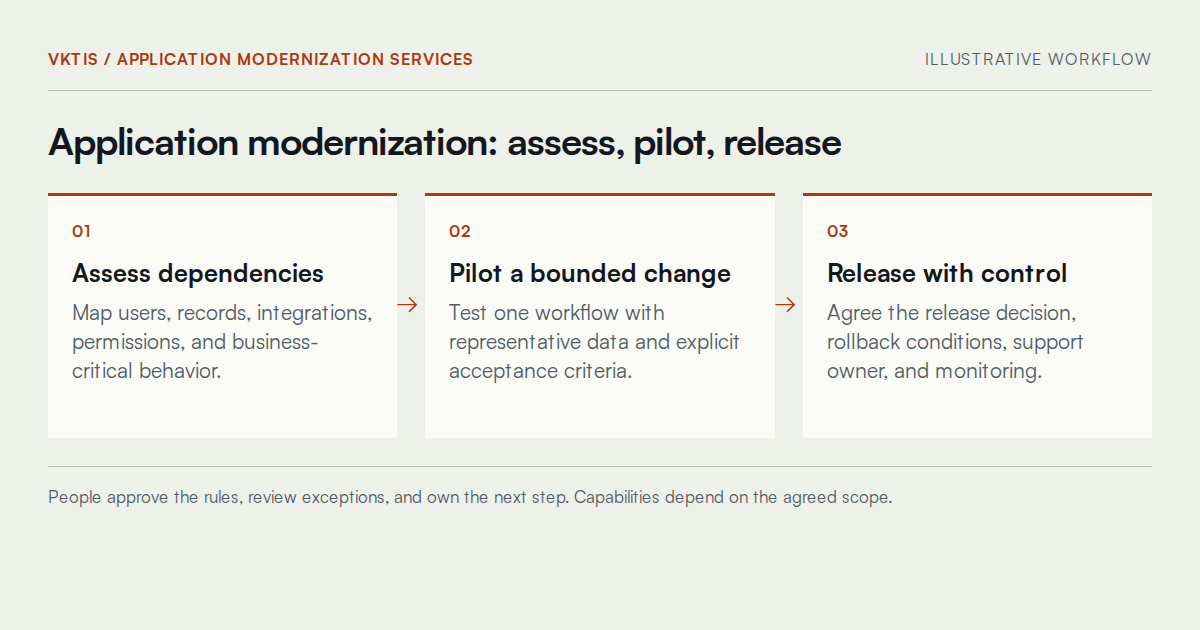
The work is structured around three repeatable phases: assessing the current state and its dependencies, scoping a bounded pilot with defined acceptance criteria, and releasing changes with an agreed rollback plan and a named support owner. Throughout every phase, business and technical decisions remain with the people accountable for them.

What the Assessment Covers
A current-state review documents the users, records, integrations, permissions, and business-critical behaviors tied to the existing application. VKTIS maps data ownership, maintenance exposure, and the informal knowledge embedded in how staff actually use the system, not just how it was designed to be used.
Understanding the Options Before Choosing One
Once the current state is documented, VKTIS presents the realistic options in plain language: retain and improve the existing application, integrate a missing capability, replace a single component that creates the bottleneck, or plan a full migration. Each option is assessed for cost uncertainty, implementation risk, and what a controlled rollback would require.
This is where application modernization consulting services create practical value. The decision belongs to you. The review makes that decision less likely to produce an expensive surprise.
Legacy Application Assessment for Home Services Businesses
Home services businesses often rely on scheduling, dispatch, and customer record applications that were purchased years ago and are no longer actively supported. The risk is not always visible day to day: the application still runs, invoices still go out, and jobs still get assigned. The problem surfaces when a key staff member leaves, when an export breaks, or when the platform stops receiving security updates.
What to Preserve in a Field Operations System
Home services applications frequently contain years of customer history, pricing logic, job category structures, and route data that would be expensive to recreate. A modernization review identifies which of those assets can be migrated and which must be rebuilt. It also establishes whether the core scheduling function should be retained, replaced with a current platform, or integrated with a front-end that staff can actually use.
VKTIS can support this kind of structured review as part of a broader business consulting and operations engagement.
Legacy Application Assessment for Medical and Dental Practices
Medical and dental practices frequently carry legacy practice management software that handles billing codes, appointment scheduling, and patient record structures built around specific workflows. These applications are often deeply integrated with how front-desk staff do their jobs, and replacing them without mapping those dependencies creates real operational risk.
Compliance Context and Human Accountability
VKTIS does not make clinical determinations or automatic compliance claims. Any modernization scope involving patient records or billing workflows must include your compliance-accountable staff and, where relevant, qualified legal or compliance advisors. What VKTIS can support is the structured assessment of what the application does, what a replacement or integration would require, and how a migration could be staged to avoid disrupting appointment continuity.
For practices exploring how AI-assisted intake could fit alongside a modernized system, the AI receptionist for dentist service page describes one possible adjacent capability.
Legacy Application Assessment for HVAC Companies
HVAC companies often operate with a combination of field service applications, standalone customer databases, and manual dispatch processes that accumulated over time. A technician's mobile app may not connect to the office billing system. Seasonal demand spikes expose export failures that stay hidden during slower months. These are modernization problems, not website problems.
Scheduling, Dispatch, and Billing Integration
An HVAC modernization review focuses on the data flow between the field and the office: how jobs are created, how parts and labor are recorded, how invoices are generated, and whether those systems share data or require manual transfer. Integration is often the right first step rather than replacing the core application.
For HVAC businesses also reviewing how inbound calls are handled alongside a systems modernization, VKTIS's HVAC answering service page describes a related operational capability.
Retain, Rehost, Refactor, or Replace: Choosing Deliberately
These four options are used throughout enterprise application modernization services conversations, but they are often explained in technical terms that don't help a business owner make a decision. VKTIS translates each option into what it would cost to operate, what it would require to implement, and what the rollback would look like if the approach fails.
Rehosting moves an application to a different infrastructure without changing how it works. Refactoring changes internal structure while preserving behavior. Replacing a component addresses one bottleneck without rebuilding the whole system. A full rebuild is appropriate only when the existing system cannot meet a validated requirement that cannot be addressed any other way.
Pilot Design, Data Migration, and Regression Testing
A modernization pilot runs against a bounded part of the operation, uses representative data, and has written acceptance criteria before it begins. VKTIS does not treat the first release as an experiment; the acceptance criteria define what a successful outcome looks like and what a failed outcome requires in terms of rollback.
Data Migration Validation and Rollback Planning
Ask an application modernization consulting company to demonstrate data reconciliation. Transferred records may contain missing relationships, truncated fields, or incomplete history. Include checks in the migration plan and rehearse rollback rather than assuming it will work. Test restored records against representative business tasks before accepting the transfer.
Regression testing confirms that the critical user tasks that worked before the change still work after it. Support demand and reconciliation errors are tracked after release as part of monitoring the real outcome.
Staff Adoption and Handover Ownership
New software that staff don't use reliably produces worse outcomes than the old system it replaced. VKTIS includes training responsibilities and escalation ownership in the modernization plan from the start, not as an afterthought after the technical implementation is complete.
Who Owns What After Go-Live
Maintenance responsibility, escalation paths, and monitoring coverage must be named before a release is approved. Enterprise application modernization services that deliver a working system but no support model leave the business in a version of the same fragile position it started in. The handover plan is part of the scope agreement, not optional documentation.
What a Scoping Deliverable Actually Contains
When a modernization engagement moves past the initial conversation, VKTIS produces a written scope document before any implementation begins. That document names the application under review, the users and systems that depend on it, the option recommended and the reason the others were set aside, and the acceptance criteria that define what a successful pilot looks like. It is not a proposal deck; it is a working reference that both teams use to stay aligned throughout the engagement.
The Boundaries the Scope Document Draws
The scoping deliverable also records what is outside the engagement: untouched adjacent systems, deferred data sets, and integrations reserved for another phase. New requirements can change effort and timing. A written record gives both parties a reference when scope pressure appears and supports explicit approval of changes instead of unplanned expansion.
A Worked Example of a Scoping Decision
Consider a home services company, as an illustration, that schedules technician visits through a desktop application purchased several years ago. The application is no longer receiving updates, but it holds six years of customer history, job category pricing, and route assignments that staff know by memory. The visible problem is that the mobile app for technicians stopped syncing reliably, so dispatchers are making calls to confirm arrivals.
How the Options Would Be Evaluated in This Scenario
A retain-and-integrate approach would add a middleware layer to push job updates to technicians' devices without touching the core scheduling database. A replace approach would migrate customer history and pricing logic to a current field service platform and retire the legacy application. A component-only replacement would swap out the mobile sync function while keeping the office-side database intact until a later phase.
In this example, the scoping review would assess which customer record fields are structurally clean enough to migrate, whether the pricing logic is documented anywhere outside the application itself, and whether staff could describe their dispatch workflow independently of the tool. Those answers determine which option carries the least hidden cost. This scenario is illustrative of how a scoping conversation typically proceeds, not a documented deployment.
What Drives Cost Uncertainty in Modernization Engagements
Buyers comparing modernization quotes often find significant variation between estimates and want to understand what accounts for it. The main drivers of cost uncertainty are data quality, undocumented business logic, and the number of integrations that touch the application being changed. An application with clean, consistently structured data and well-documented workflows costs less to migrate than one where critical logic lives in staff memory or in spreadsheets that were never connected to the core system.
Where Scope Tends to Expand
Integration testing can also change the effort required. Connections to billing, scheduling, reporting, and communication tools need realistic tests, not just successful connection checks. Finding a broken relationship before release gives the team time to correct it without exposing normal operations to that defect. Post-launch errors still need a documented recovery process and an accountable support owner.
Understanding these cost components helps buyers ask better questions before selecting a vendor or approving a budget. VKTIS structures its engagements to surface those variables during scoping rather than after implementation begins. Teams that want to understand how a workflow audit might reduce that uncertainty before committing to a modernization scope can review the workflow audit services page for context on that earlier step.
Keep a record of accepted limitations. Staff need to understand what the first release leaves unchanged.
A Useful First Step
The most productive first conversation about application modernization describes the application, the people who use it, and the specific friction or risk that prompted the review. You do not need a technical specification; you need to be able to say what the system does, who would notice if it stopped working, and what you have tried already.
VKTIS reviews that picture and identifies whether the engagement is feasible, what expertise it would require, and what a scoped assessment would cover. That is the decision point, not a commitment to a full implementation.
If you're ready to describe your current setup, schedule a 15-minute intro call or send a message through the contact page. Please do not include sensitive patient, customer, or financial records in an initial inquiry form.